


I didn’t expect to cry watching Roman Holiday. I knew it would be a beautiful romantic film I’d enjoy watching, but it was so much more than that. Be prepared to go through an entire rollercoaster of infallible, beautifully chaotic emotions.
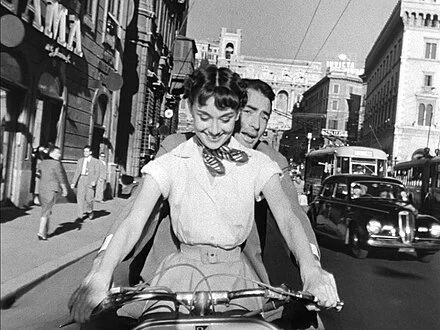
The rush you feel when watching it kicks in halfway through. At the beginning, you’re simply intrigued by the lovely Audrey Hepburn as Princess Anne, and the incredible Gregory Peck as Joe Bradley. In the first half hour or so, you’re interested in how the film will turn out. Then, when Princess Anne makes a run for it from her country’s embassy, meets Joe Bradley for the first time and goes on a whole series of adventures in Rome, the emotions kick in once they fall in love and dance.
The moment is completely timeless. The princess enjoying a simple, unobserved dance for the first time, and Joe enjoying the company of someone he never thought he’d meet. It’s something out of a fairytale; something they’ll both remember forever. Now in this moment, both seem to forget that they’re from completely different worlds, but when the secret service men locate the princess, that’s when everything turns chaotic.
Audrey Hepburn and Gregory Peck
Princess Anne starts to panic, thinking about the horror of returning home, and Joe is frantic, trying his best to save her. It’s completely rambunctious until finally, they make an escape. Here, romance makes an entrance. The pair has their first kiss and get a glimpse of what it truly means to love. As the night goes on, it goes from excitement, to passion, and then to mourning. Soon, the princess understands she must leave. Joe understands as well.
Both are heartbroken, completely out of it, and then they embrace. Their second embrace on the way back to the embassy is their last. It’s heart-wrenching to watch because they both know it’s something they’ll never get to do again. Towards the end of the film, the emotion you go through is one of defeat, because after experiencing every kind of emotion there is (from intrigue, to excitement, to laughter, to tears of joy, anticipation and sadness), you simply accept that there is no fairytale happy ending. Princess Anne won’t marry Bradley, and they won’t end up together.
In the final moments of the film, when the pair look at each other for the last time, you just know there is a sense of defeat. There is a sense of longing to cross the threshold that’s keeping them apart and embrace one another again. The acting is brilliant, the directing and editing as well. It’s simply flawless because it leaves you completely moved as a viewer. An audience member must accept defeat as well because the happy ending they want for the characters will not really happen.
When so many romance films these days have that typical, must-have happy ending, you have the slight or gigantic expectation that Roman Holiday might be like that, too. It wasn’t, and that’s okay. But I somehow think it ended the way it was supposed to. Somehow, it showed that the “holiday” the characters went on, the adventure of a lifetime, was just that, a holiday. And now it’s time to go back to their own lives. It’s like a little sprinkle of reality after all that magic.
All in all, Roman Holiday is an incredible film. A no-brainer must-watch. Most importantly, the emotions are truly there.
-written by May Zaben